Political Theory

Hardwired Hirarchy

Thinking about coordination of human activities I can’t help but wonder – do we have a hardwired tendency for hirarchical coordination? Is there some sort of biological reason for people’s need to have an ordered society?

Is this simply about assigning responsibilities and easily finding the culprit(s) when the damage occurs or could it possibly have something to do with fundamental behavioral tendencies of the animal in us?

If Hayek is right that chaos is more effective and creative but humans can’t lastingly deal with the challenges of that chaos, could there be a biological element to the “centralising” movements that created vast socio-economic- all-encompassing-monopolistic hierarchies (Communism, Naszim)?

Standard
compulsory reading, German Politics, media, Political Theory

High Noon

Well, it was about time. Being a mature liberal democracy with television, it was only a matter of time until there would be a televised duel between the two most serious contenders for Germany’s most important political office, the chancellor.

Yesterday evening, 20:15 was the hour of truth for both contestants. Given that this sort of two-man-show is a new element in German campaigning, it is understandable that both Mssrs. had some trouble to find the right way to deal with the other.

There were no fatal mistakes, no watch-checking, no claims about Eastern Europe being still under Soviet control. Actually, the duel was not actually a duel. The contestants hardly spoke or even looked at each other. Nor did they look at me (or the other estimated 14m viewers, which equals appr. 50% prime-time market share) since cameras, contestants and the two interviewing journalists were placed in a way it appeared the two men simply looked nowhere when they were actually looking at the journalists. Seriously, I wonder if they should pay their campaign advisors.

So the event is the main story. And for all the pundits being interviewed afterwards this was in all likelyhood a very profitable evening. But for the rest of us and for our democracy, the debate (that was not) was not very helpful.

By the way, the (conservative) BILD-Zeitung has apparently decided that Edmund Stoiber won. Actually, a lot of people said that today. Such commentary is a good example of the fact that pessimists tend to be more effetive than optimists, because because their “should be / is”-fraction will always be higher. Stoiber won simply because everyone expected him to perform as abysmal as he did in the first one-hour interview after his nomination as CDU/CSU candidate.

So to sum up, we did a) not learn anything interesting about policy options in the debate (that was not), b) we have a winner because a duel by definition needs a winner and c) unfortunately, that “winner” only because he tragically lowered expectations by himself. It’s a bit like the soaring approval ratings for George W. Bush after his handling of 9/11. Most people expected him to fail so they were positively surprised when he did not (fail entirely).

Note: It is evident why a televised debate is being introduced in Germany just now, but interestingly, it is less certain than in many previous elections that the voters will get the chancellor the want. Germany is a parliamentary democracy and the public elects the parliament, not the government. As no single party will be able to get 50+% of the votes, they will need to form coalition.

This, in turn, means that the candidate who received the most votes will not necessarily become chancellor. It all depends on the vote distribution between the parties. And given current trends, the FDP might well choose the SPD over the CDU as a coalition partner as they would have more weight in such a coalition. So Schroeder could stay in office despite getting less votes than Stoiber. Now this is a logical possibility of a parliamentary democracy and far less problematic than in the case of the last American election.

From here, the discussion would become increasingly theoretical and thus I will spare you (and me) tonight. Whatever the public says (through elections or otherwise) there is no correct way to translate it into majorities. It’s just an (socialised) agreement.


Standard
almost a diary, self-referential, songwriting

Fool Cruel Gone One

UPDATE

(26/01/2007) The songs has been published on my demo album Quarterlife in late 2005. Check it out here.

I never thought I could write lyrics. But the above title tells you that I did. Still very pleased with myself. Seriously, isn’t it nice to discover a previously hidden creative side in oneself?

Once the song is produced, you’ll get your chance to listen right here on this site. Stay tuned.

Standard
USA

Tough Times Ahead For Napsters?

The US might begin to indict p2p users for criminal charges who share (offer – not download) copyrighted material in excess of $1000, US deputy attorney general John Malcom said today (link in German).

I would recommend to have a look at the transaction cost theory literature before publicly stating stuff like that. But as you might remember from earlier statements: It’s a war out there and in a war, only very few people behave rationally…

Standard
Political Theory

Is the bottom line really chapter 32, in part VIII of volume one?

Oxford’s Niall Ferguson thinks that Marx’s thoughts about crisis prone capitalism should be given more attention in light of the not so recently past days of “CEOcracy” and increased income inequality in the US.

But today, Ferguson claims, the class struggle is not waged between workers and owners but between ordinary shareholders and their CEO and controlling oligarchs, so the Marxian acculmulation theory could have a point. In the end, he somewhat loses track and the article becomes more of a summary of recent estimates of American growth prospects. And he never tells us what the consequences could be if the analogy were correct.

But anyway. Could it be true? Could Marx be headed for big comeback in the digital age? I am very sceptical. Altough I do think that he has created a scary seductive beast whose feared return will likely scare this planet for some decades to come.

Standard
USA

Times are(n’t) a changing?

I am reading William Easterly’s account of the “Elusive Quest For Growth” in the developing world. This is a quote from page 25.

“On March 6, 1957, the Gold Coast, a small British colony became the first nation of sub-Saharan Africa to gain its independence. I renamed itself Ghana. […] Vice President Richard nixon led the American delegation. (According to one source, Nixon asked a group of black journalists, ‘What does it fell like to be free?’ ‘We don’t know,’ they replied, ‘we’re from Alabama.’)”

Thought it’s worth noting after yesterday’s entry about the NYTimes article about that imaginary homicide case in Alabama.

Standard
German Politics, Germany

Too much water. And Moral Hazard.

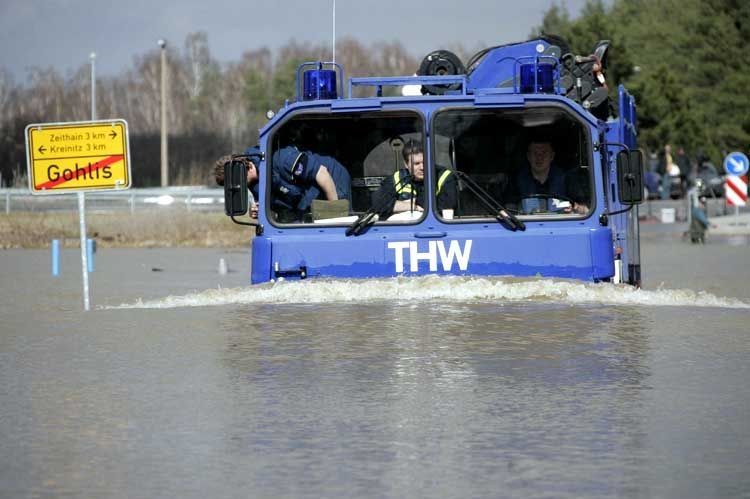
THW Hochwassereinsatz DeutschlandFaced with the destruction of the floods currently covering a good part of East Germany and the Czech Republic, more than 4m victims will only be able to deplore their impotence with regard to the destructive potence of nature and to feel the anxiety of not knowing how to go on with their lives.

It is truly a tragedy what is happening these days after 12 years of reconstruction in the formerly Communist East. But for all their losses, none of the victims is faced with the moral dilemma which German government politicians will have to tackle. On the one hand, their human hand, they will feel compassionate just like everyone else (and will deplore the budgetary consequences of generous government bailouts for the affected regions). On the other, their (party) political one, they will see the enormous potential this national crisis is offering to them in public relation terms with the general elections looming in five weeks. But then, their private smugness will certainly be offset by the mourning of opposition leaders…

Standard
USA

Civil Right (wings) in the US.

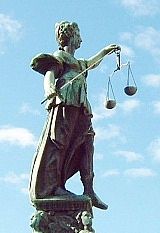
JustitiaSeriously, what is going on with civil rights in the US? Last week I already reported NYTimes articles regarding the jailing of half a community of apparently innocent black people for alleged drug dealing in Tulia, Texas, US.

Now the NYTimes reports another instance of “jurisprudence” that makes me want to vomit. This time the incident has been taking place in Alabama. Apparently, three mentally ill black people have been talked into confessing to manslaughter of a non-existing baby and have accordingly been punished. It’s so absurd I can hardly believe it.

I must state, of course, the disclaimer that no legal system is free of flaws (implied in the word ‘system’, which in essence means that general rules are applied to individual cases in order to keep the complexity manageable. It seems therefore unavoidable to accept that a certain number of individual cases will not be dealt with adequately in any system (legal, mental, social or digital, etc.).

But that recourse is only available to non-abusive, non-biased legal systems in VERY few, VERY problematic cases. The one noted above does not seem to be difficult. But it does seem racially biased.

Standard
cinema

Wise Men (in Black) Say…

WISE MEN SAYLast night I watched the first part of “Men in Black” again. And I noticed it features an immensely wise line which I won’t withhold from you, of course. Agent K (Tommy Lee Jones) is explaining to prospective Agent J (Will Smith) why the existence of extraterrestrial intelligent life on earth must be kept hidden from the public:

“One human is intelligent, but a bunch of humans are dumb hysterical dangerous animals.”

Note that I retranslated the line from the German version, so I don’t know the original words. Strangely enough, this line has not made it to the memorable ones on imdb.com.

Standard